


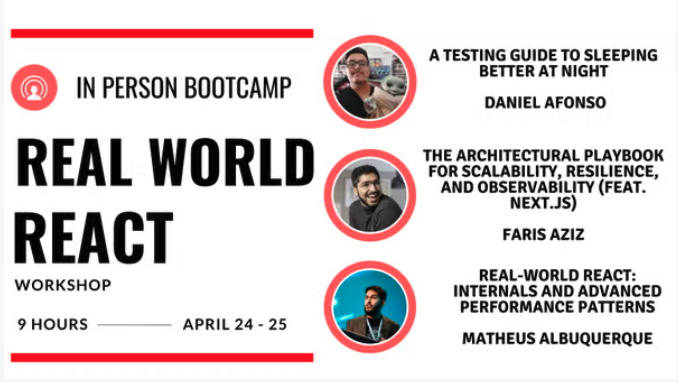
Internals and Advanced Performance Patterns
Writing fluid user interfaces becomes more and more challenging as the application complexity increases. Also, in a world with a wide variety of network connections, any user can have a slow experience, and apps that delight users on fast connections can barely be usable on slow ones. Leveraging real-world case studies from small, medium, and enterprise-scale companies, in this workshop, we will:
↝ Have an in-depth overview of the important concepts behind reconciliation and React Fiber and and go through a few magic words we hear a lot, like coroutines, generators, and more.
↝ Explore how proper scheduling can improve your app’s experience by diving into some concurrent React features, understanding their rationales, and how they work under the hood.
↝ Discuss a wide range of performance APIs native to the Web Platform itself.
↝ See how to measure responsiveness, and reliably identify culprits for bad experiences.
↝ Discuss how to apply modern techniques to legacy codebases, via code generation, polyfilling, and many other tips and tricks for large platforms targeting emerging markets.


JavaScript Monthly London Meetup
Javascript evolution has sped up (a lot) in recent years and event the most veterans developers find it hard to keep up with the latest trends. This meetup group aims to bring you monthly bite-sized updates on the world of Javascript along with a healthy dose of nice people, beer and pizza.
Please use your full name when registering, as some of our venues require a full list of attendees beforehand. You have an idea and you want to be a speaker?We are always looking for more speakers - submit your talk here (https://docs.google.com/forms/d/e/1FAIpQLSdFaatfveOUbrmer47jYb5J4J4ttxAFc1CgTjUDltBXmDOJmg/viewform)





Platform Sponsors

Supercharge your dev team with AI code reviews
Get your free trial now

Torc is a community-first platform bringing together remote-first software engineer and developer opportunities from across the globe. Join a network that’s all about connection, collaboration, and finding your next big move — together.
Join our community today!
Internals and Advanced Performance Patterns
Writing fluid user interfaces becomes more and more challenging as the application complexity increases. Also, in a world with a wide variety of network connections, any user can have a slow experience, and apps that delight users on fast connections can barely be usable on slow ones. Leveraging real-world case studies from small, medium, and enterprise-scale companies, in this workshop, we will:
↝ Have an in-depth overview of the important concepts behind reconciliation and React Fiber and and go through a few magic words we hear a lot, like coroutines, generators, and more.
↝ Explore how proper scheduling can improve your app’s experience by diving into some concurrent React features, understanding their rationales, and how they work under the hood.
↝ Discuss a wide range of performance APIs native to the Web Platform itself.
↝ See how to measure responsiveness, and reliably identify culprits for bad experiences.
↝ Discuss how to apply modern techniques to legacy codebases, via code generation, polyfilling, and many other tips and tricks for large platforms targeting emerging markets.
JavaScript Monthly London Meetup
Javascript evolution has sped up (a lot) in recent years and event the most veterans developers find it hard to keep up with the latest trends. This meetup group aims to bring you monthly bite-sized updates on the world of Javascript along with a healthy dose of nice people, beer and pizza.
Please use your full name when registering, as some of our venues require a full list of attendees beforehand. You have an idea and you want to be a speaker?We are always looking for more speakers - submit your talk here (https://docs.google.com/forms/d/e/1FAIpQLSdFaatfveOUbrmer47jYb5J4J4ttxAFc1CgTjUDltBXmDOJmg/viewform)
Platform Sponsors
Supercharge your dev team with AI code reviews
Get your free trial now
Torc is a community-first platform bringing together remote-first software engineer and developer opportunities from across the globe. Join a network that’s all about connection, collaboration, and finding your next big move — together.
Join our community today!
Get in touch!
hi@guild.host