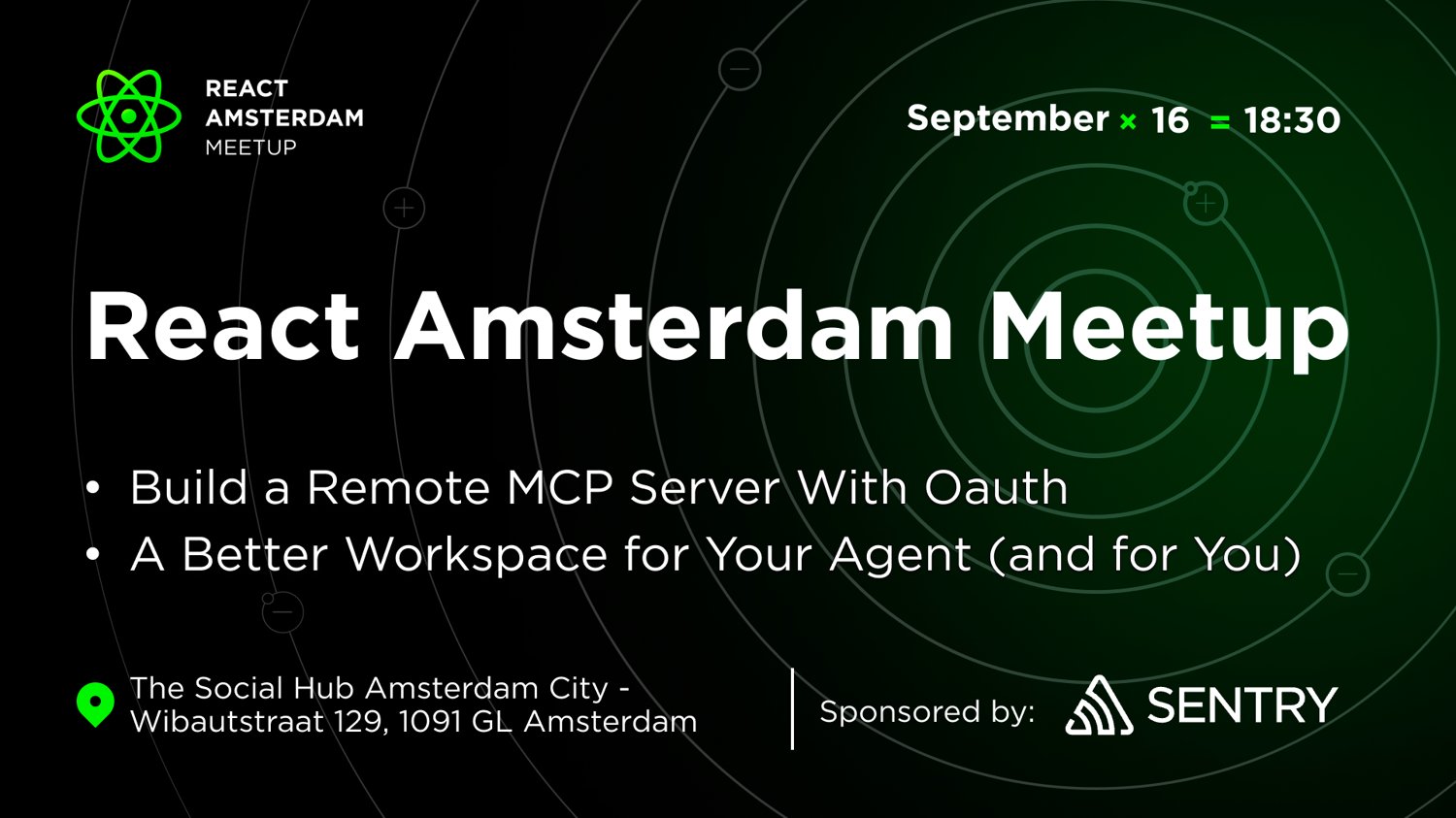
A Better Workspace for Your Agent (and for You)

Presentation byAlireza Sheikholmolouki

Our coding agents are getting smarter, but the workspace we drop them into is probably not enabling them to use their full potential. The decisions, failed attempts, conventions, and product knowledge are still crucial context scattered across people’s heads, Confluence, old conversations, and forgotten pull‑request comments.

During this talk, we'll walk through the shift from the “good old” prompt engineering to agent experience, then I'll show a practical AX experiment at my current company that led to a better workspace for both agents and the people using them.

Presented with these Guilds
Cover Photo for React Amsterdam
Primary Photo for React Amsterdam

React Amsterdam

React Amsterdam is a community organizing quarterly Meetups and an annual Conference on all things React https://reactsummit.com.

Being the oldest ReactJS community in BeNeLux it gathers Front-end developers across the globe in the tech heart of Europe. With internationally recognized speakers, amazing attendee crowd and a top location.

Contact email: events@gitnation.org

📝 Submit your talk for coming events here

If your company has a space to host our next event, please reach us here

By joining this group you agree to comply to our Code of Conduct

1.2KMembers
Similar Presentations
Cover Photo for From Executor to Orchestrator: The New Developer Paradigm

From Executor to Orchestrator: The New Developer Paradigm

Format: Technical talk with live demos, code and prompt examples

Description:

The role of the developer is fundamentally changing. We're moving from being executors who write every line of code to becoming orchestrators who conduct AI agents to build complex systems. This talk, based on my essay about transitioning from traditional coding to AI orchestration, shares practical insights from a year of experimenting with multi-agent development workflows. 🔗 Essay linked here: https://pivotech.substack.com/p/from-executor-to-orchestrator-my

Through real code examples and live demonstrations, I'll walk through my evolution from using ChatGPT for learning CS50 concepts to orchestrating Claude, Gemini CLI, and NotebookLM to build complete products. You'll discover the three distinct schools of AI development I've identified through hands-on experimentation: the One-Shot method, the Incremental approach, and my hybrid Layering technique.

I'll share the workflows I use to go from customer discovery sessions to deployed applications, including the mistakes, frustrations, and breakthroughs that shaped my approach. We'll explore the "Legacy Codebase Problem" that emerges from AI-generated code, the "Hyper-specificity Paradox" of detailed prompting, and the new skill set required to become an effective AI orchestrator.

Key Takeaways:

Three proven patterns for AI-assisted development and when to use each

Practical orchestration workflows for complex projects

The emerging skillset of the developer-orchestrator

How to maintain technical depth while leveraging AI efficiency

Real-world pitfalls and how to navigate them

Target Audience: Developers looking to evolve their practice in the age of intelligent agents. Minimal level of AI development experience required e.g. prompting Claude

Nkechi Anyanwu

A Better Workspace for Your Agent (and for You)

Presentation byAlireza Sheikholmolouki

Our coding agents are getting smarter, but the workspace we drop them into is probably not enabling them to use their full potential. The decisions, failed attempts, conventions, and product knowledge are still crucial context scattered across people’s heads, Confluence, old conversations, and forgotten pull‑request comments.

During this talk, we'll walk through the shift from the “good old” prompt engineering to agent experience, then I'll show a practical AX experiment at my current company that led to a better workspace for both agents and the people using them.

Presented with these Guilds
Cover Photo for React Amsterdam
Primary Photo for React Amsterdam

React Amsterdam

React Amsterdam is a community organizing quarterly Meetups and an annual Conference on all things React https://reactsummit.com.

Being the oldest ReactJS community in BeNeLux it gathers Front-end developers across the globe in the tech heart of Europe. With internationally recognized speakers, amazing attendee crowd and a top location.

Contact email: events@gitnation.org

📝 Submit your talk for coming events here

If your company has a space to host our next event, please reach us here

By joining this group you agree to comply to our Code of Conduct
1.2KMembers
Similar Presentations
Cover Photo for From Executor to Orchestrator: The New Developer Paradigm

From Executor to Orchestrator: The New Developer Paradigm

Format: Technical talk with live demos, code and prompt examples

Description:

The role of the developer is fundamentally changing. We're moving from being executors who write every line of code to becoming orchestrators who conduct AI agents to build complex systems. This talk, based on my essay about transitioning from traditional coding to AI orchestration, shares practical insights from a year of experimenting with multi-agent development workflows. 🔗 Essay linked here: https://pivotech.substack.com/p/from-executor-to-orchestrator-my

Through real code examples and live demonstrations, I'll walk through my evolution from using ChatGPT for learning CS50 concepts to orchestrating Claude, Gemini CLI, and NotebookLM to build complete products. You'll discover the three distinct schools of AI development I've identified through hands-on experimentation: the One-Shot method, the Incremental approach, and my hybrid Layering technique.

I'll share the workflows I use to go from customer discovery sessions to deployed applications, including the mistakes, frustrations, and breakthroughs that shaped my approach. We'll explore the "Legacy Codebase Problem" that emerges from AI-generated code, the "Hyper-specificity Paradox" of detailed prompting, and the new skill set required to become an effective AI orchestrator.

Key Takeaways:

Three proven patterns for AI-assisted development and when to use each

Practical orchestration workflows for complex projects

The emerging skillset of the developer-orchestrator

How to maintain technical depth while leveraging AI efficiency

Real-world pitfalls and how to navigate them

Target Audience: Developers looking to evolve their practice in the age of intelligent agents. Minimal level of AI development experience required e.g. prompting Claude

Nkechi Anyanwu