


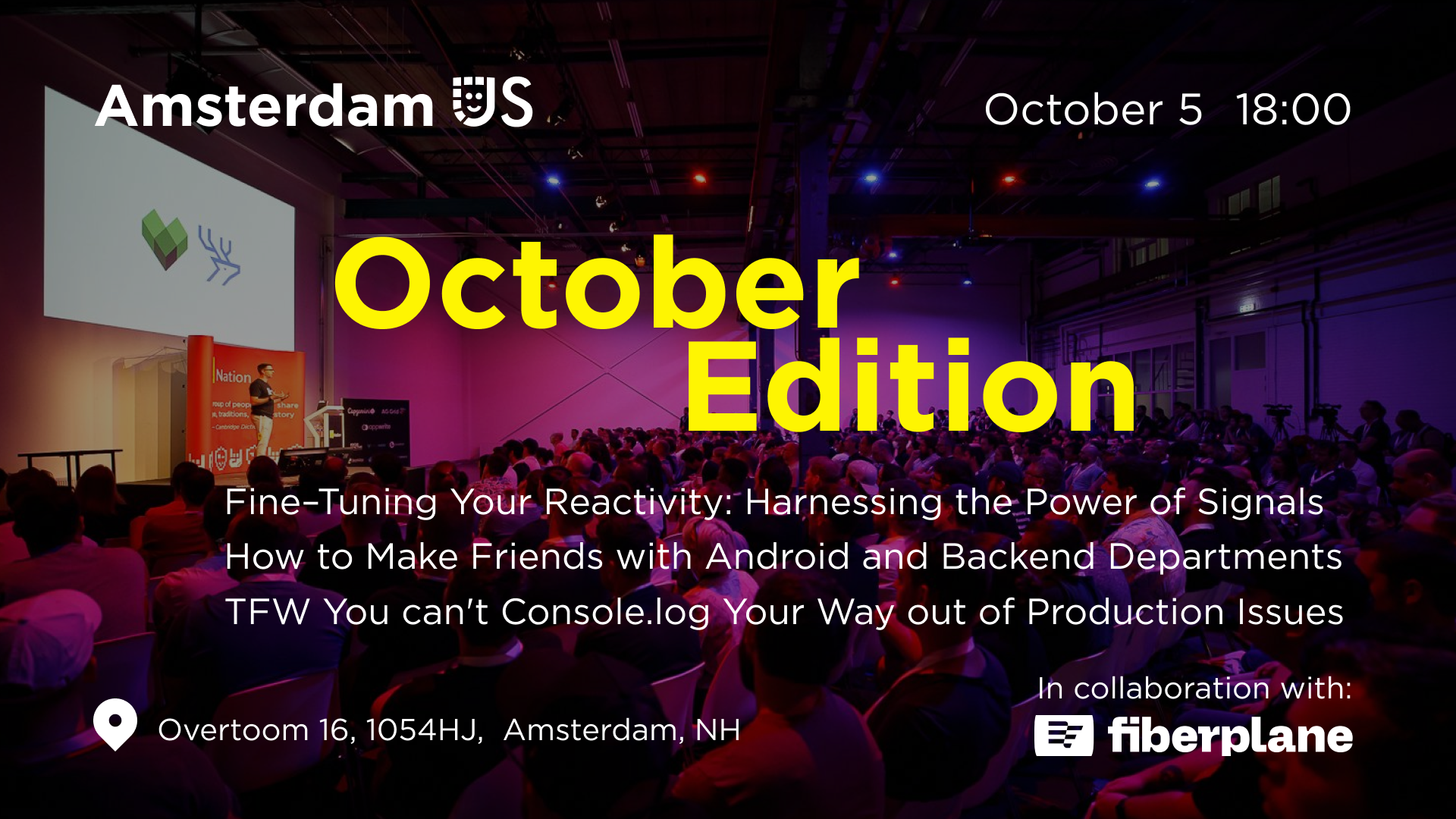
TFW You can't Console.log Your Way out of Production Issues
Congrats, you deployed your Node app to prod! But how do you actually know if your users are having a good experience? Logs are great initially—until your dashboard becomes overwhelming. We could add metrics but they have a steep learning curve. In this talk we'll see where console.log falls short and learn how metrics help us better define what a good user experience is. We'll also discuss why useful code instrumentation is hard, and propose what we can do to make it easier.

AmsterdamJS
AmsterdamJS is the largest and longest-running JavaScript meetup in town!
JavaScript has a bright shining future and the Amsterdam tech scene is thriving. Although there are vibrant user meetups and conferences on related topics, the city needs a strong and all-embracing JavaScript community and AmsterdamJS is it, since 2010.
Our goal is to cover everything JavaScript, from the browser to the server, from the framework to the crazy hack and from the hardware appliance to the data visualization. We also run an annual conference - JSNation
Contact email: events@gitnation.org
Submit your talk proposals here
Propose the venue for next meetups https://shorturl.at/nuxQ1
By joining this group you agree to comply to our Code of Conduct https://jsnation.com/coc



Platform Sponsors

Torc is a community-first platform bringing together remote-first software engineer and developer opportunities from across the globe. Join a network that’s all about connection, collaboration, and finding your next big move — together.
Join our community today!

Supercharge your dev team with AI code reviews
Get your free trial now
TFW You can't Console.log Your Way out of Production Issues
Congrats, you deployed your Node app to prod! But how do you actually know if your users are having a good experience? Logs are great initially—until your dashboard becomes overwhelming. We could add metrics but they have a steep learning curve. In this talk we'll see where console.log falls short and learn how metrics help us better define what a good user experience is. We'll also discuss why useful code instrumentation is hard, and propose what we can do to make it easier.
AmsterdamJS
AmsterdamJS is the largest and longest-running JavaScript meetup in town!
JavaScript has a bright shining future and the Amsterdam tech scene is thriving. Although there are vibrant user meetups and conferences on related topics, the city needs a strong and all-embracing JavaScript community and AmsterdamJS is it, since 2010.
Our goal is to cover everything JavaScript, from the browser to the server, from the framework to the crazy hack and from the hardware appliance to the data visualization. We also run an annual conference - JSNation
Contact email: events@gitnation.org
Submit your talk proposals here
Propose the venue for next meetups https://shorturl.at/nuxQ1
By joining this group you agree to comply to our Code of Conduct https://jsnation.com/coc
Platform Sponsors
Torc is a community-first platform bringing together remote-first software engineer and developer opportunities from across the globe. Join a network that’s all about connection, collaboration, and finding your next big move — together.
Join our community today!
Supercharge your dev team with AI code reviews
Get your free trial now
Get in touch!
hi@guild.host