


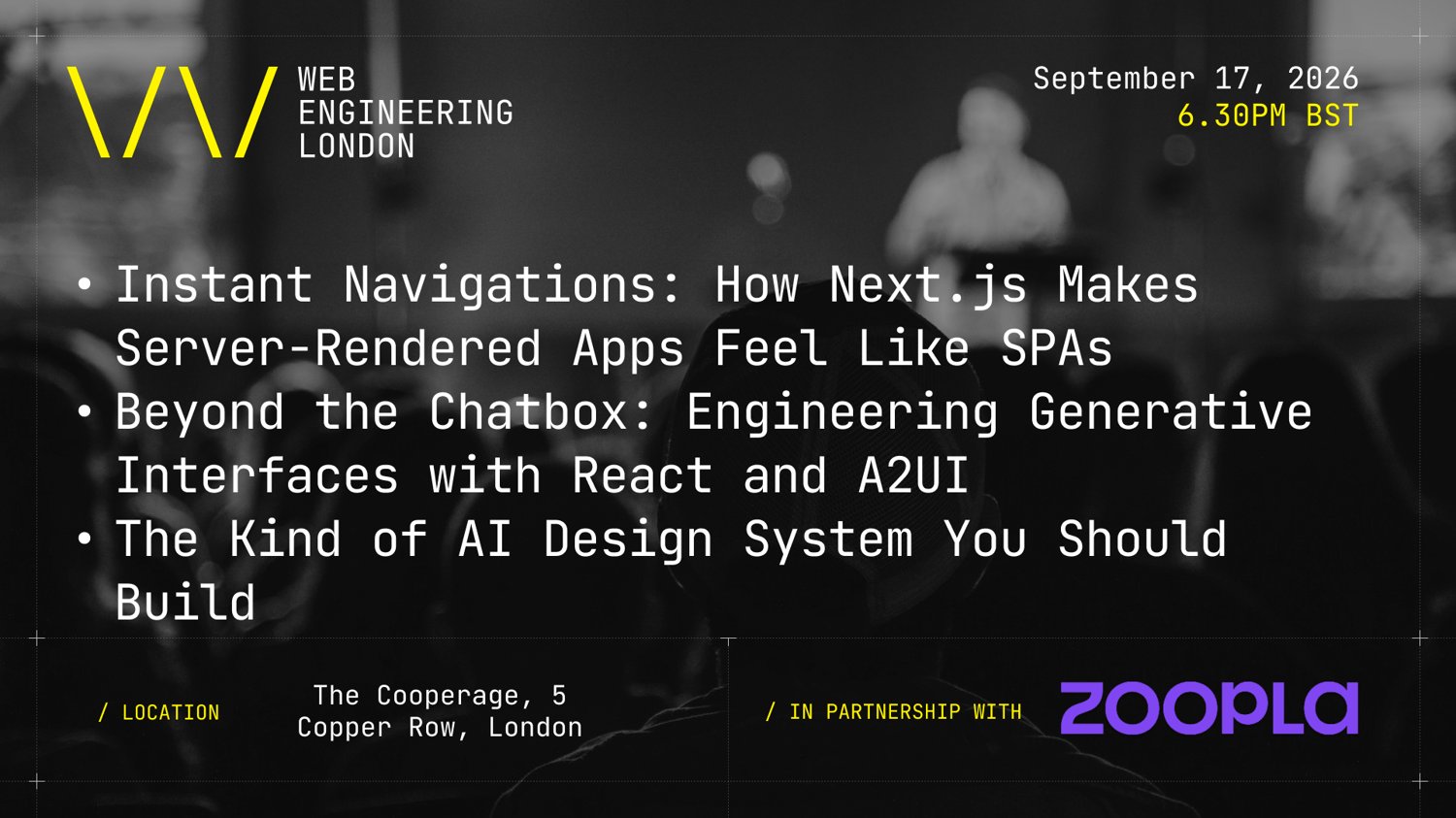
The Kind of AI Design System You Should Build
Most teams hear "AI design system" and reach for the thing they already know: a component library, now with a chat panel bolted onto it. I think that's the wrong shape. A design system in an AI-assisted codebase isn't a catalogue of components; it's a set of architectural contracts that a coding agent can actually be held to. Tokens, composition rules, and constraints that are legible to a model, not just to a designer in Figma.
The talk walks through what that looks like in practice: what an agent gets wrong when your system is only documented in prose, how to encode intent so the generated code is boringly consistent instead of plausibly wrong, and where the boundary sits between what you let a model generate and what you pin down by hand.
What attendees can expect to take away:
- A working definition of an AI design system that isn't just "components plus autocomplete"
- The failure modes I've hit shipping React/TypeScript UI with coding agents, with real examples
- Concrete techniques for encoding design constraints so agents produce consistent output
- A sense of what to fix first if their current system is fighting their tooling rather than helping it
It's aimed at frontend and product engineers, and at design-system maintainers wondering what to do about all this. No prior AI-tooling experience needed.


Web Engineering London (React Advanced)
React Advanced London is a community organizing quarterly in-person events and an annual hybrid conference in October.
Engineers of all levels are welcome to join, our meetups are always free to attend and a great place to meet other likeminded people and share some insights about your work and experience from the stage.
Contact email: hi@reactadvanced.com
Want to give a talk at our next meetup? We welcome talk ranging from 5 to 20 min length on any topic related to React and/or React Native, submit them here and we'll be in touch https://forms.gle/rCiQ8Y4jajiC8AHMA
Venue proposal from: https://shorturl.at/FOT34
By joining this group you agree to comply to our Code of Conduct




Platform Sponsors

Supercharge your dev team with AI code reviews
Get your free trial now

Torc is a community-first platform bringing together remote-first software engineer and developer opportunities from across the globe. Join a network that’s all about connection, collaboration, and finding your next big move — together.
Join our community today!
The Kind of AI Design System You Should Build
Most teams hear "AI design system" and reach for the thing they already know: a component library, now with a chat panel bolted onto it. I think that's the wrong shape. A design system in an AI-assisted codebase isn't a catalogue of components; it's a set of architectural contracts that a coding agent can actually be held to. Tokens, composition rules, and constraints that are legible to a model, not just to a designer in Figma.
The talk walks through what that looks like in practice: what an agent gets wrong when your system is only documented in prose, how to encode intent so the generated code is boringly consistent instead of plausibly wrong, and where the boundary sits between what you let a model generate and what you pin down by hand.
What attendees can expect to take away:
- A working definition of an AI design system that isn't just "components plus autocomplete"
- The failure modes I've hit shipping React/TypeScript UI with coding agents, with real examples
- Concrete techniques for encoding design constraints so agents produce consistent output
- A sense of what to fix first if their current system is fighting their tooling rather than helping it
It's aimed at frontend and product engineers, and at design-system maintainers wondering what to do about all this. No prior AI-tooling experience needed.
Web Engineering London (React Advanced)
React Advanced London is a community organizing quarterly in-person events and an annual hybrid conference in October.
Engineers of all levels are welcome to join, our meetups are always free to attend and a great place to meet other likeminded people and share some insights about your work and experience from the stage.
Contact email: hi@reactadvanced.com
Want to give a talk at our next meetup? We welcome talk ranging from 5 to 20 min length on any topic related to React and/or React Native, submit them here and we'll be in touch https://forms.gle/rCiQ8Y4jajiC8AHMA
Venue proposal from: https://shorturl.at/FOT34
By joining this group you agree to comply to our Code of Conduct
Platform Sponsors
Supercharge your dev team with AI code reviews
Get your free trial now
Torc is a community-first platform bringing together remote-first software engineer and developer opportunities from across the globe. Join a network that’s all about connection, collaboration, and finding your next big move — together.
Join our community today!
Get in touch!
hi@guild.host