


Doing the Bare Minimum with Isograph
In a web app, the enemy of performance isn't bad algorithms — it's bloat. From loading the least data and JavaScript to re-rendering the fewest components in response to changes in state, the most performant apps are the one that do the least. But it's often hard to maintain a small bundle while iterating on features.
Enter Isograph, the framework for building data-driven React apps. It leverages a compiler to provide great DevEx and performance, right out of the box.
In this talk, find out how Isograph lets you:
- load component JavaScript and data only when needed, for example when the user is about to scroll to them
- load components (such as a VideoViewer) only if an item of that type (a Video) is returned from the server, and
- defer loading parts of your component tree, without server support.
And the cherry on top? We're doing it all in userland. 😎
But wait, there's more! We'll also show how Isograph re-renders the absolute minimum of components and garbage collects data that's no longer needed, allowing your app to stay consistently performant. So let's prove the old adage: less is more performant.
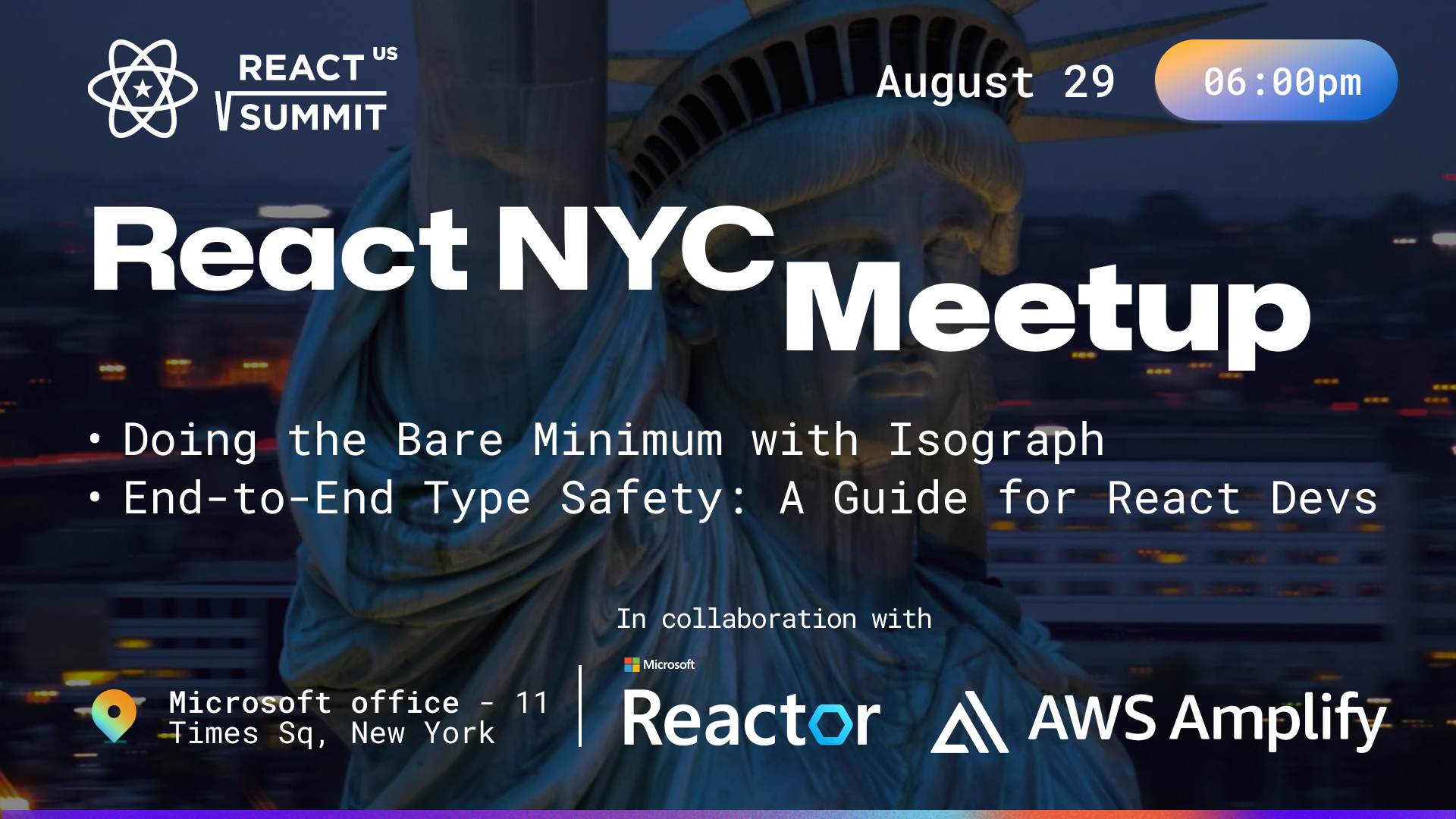


React.NYC
The React.NYC Meetup is a group for React, React Native and JavaScript developers in NYC. We meet at least once in a quarter (or more often if have venues proposed) to listen to 3-4 presentations, share, learn, connect with other engineers, and have fun!
Summit your talk proposals via this form (5 to 30 min) https://forms.gle/ipAtW1trLcuUdzpx6
If your company can host our next event or you have questions, reach us https://forms.gle/pj4b7U3de1Dis1xv7
Meetup currently run with support of React Summit US and useReactNYC
Follow us on twitter https://twitter.com/reactsummit
Watch pervious recordings at youtube.com/ReactNYC
We expect all speakers and attendees to follow our Code of Conduct




Platform Sponsors

Supercharge your dev team with AI code reviews
Get your free trial now

Torc is a community-first platform bringing together remote-first software engineer and developer opportunities from across the globe. Join a network that’s all about connection, collaboration, and finding your next big move — together.
Join our community today!
Doing the Bare Minimum with Isograph
In a web app, the enemy of performance isn't bad algorithms — it's bloat. From loading the least data and JavaScript to re-rendering the fewest components in response to changes in state, the most performant apps are the one that do the least. But it's often hard to maintain a small bundle while iterating on features.
Enter Isograph, the framework for building data-driven React apps. It leverages a compiler to provide great DevEx and performance, right out of the box.
In this talk, find out how Isograph lets you:
- load component JavaScript and data only when needed, for example when the user is about to scroll to them
- load components (such as a VideoViewer) only if an item of that type (a Video) is returned from the server, and
- defer loading parts of your component tree, without server support.
And the cherry on top? We're doing it all in userland. 😎
But wait, there's more! We'll also show how Isograph re-renders the absolute minimum of components and garbage collects data that's no longer needed, allowing your app to stay consistently performant. So let's prove the old adage: less is more performant.
React.NYC
The React.NYC Meetup is a group for React, React Native and JavaScript developers in NYC. We meet at least once in a quarter (or more often if have venues proposed) to listen to 3-4 presentations, share, learn, connect with other engineers, and have fun!
Summit your talk proposals via this form (5 to 30 min) https://forms.gle/ipAtW1trLcuUdzpx6
If your company can host our next event or you have questions, reach us https://forms.gle/pj4b7U3de1Dis1xv7
Meetup currently run with support of React Summit US and useReactNYC
Follow us on twitter https://twitter.com/reactsummit
Watch pervious recordings at youtube.com/ReactNYC
We expect all speakers and attendees to follow our Code of Conduct
Platform Sponsors
Supercharge your dev team with AI code reviews
Get your free trial now
Torc is a community-first platform bringing together remote-first software engineer and developer opportunities from across the globe. Join a network that’s all about connection, collaboration, and finding your next big move — together.
Join our community today!
Get in touch!
hi@guild.host